


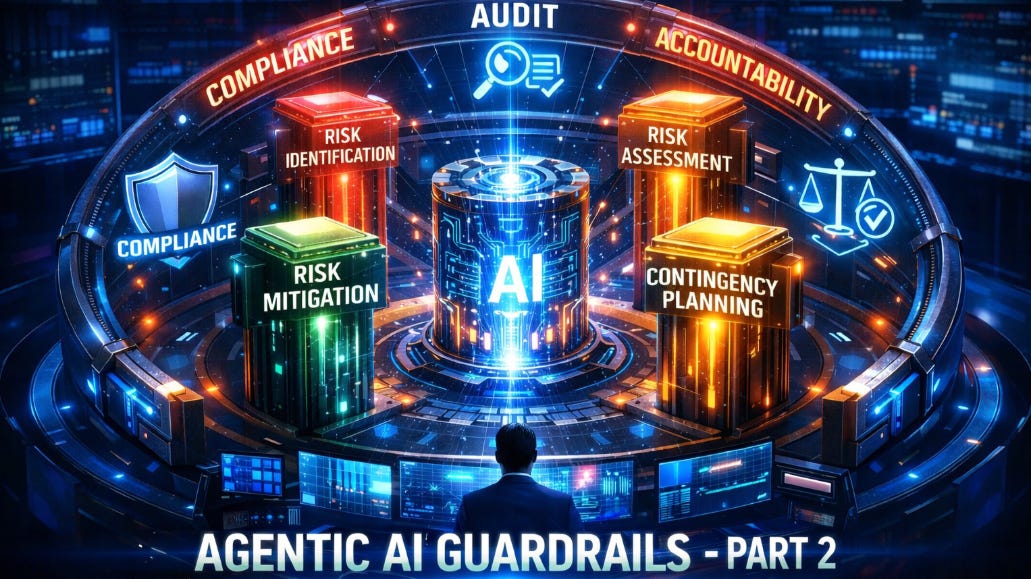
Recap: What We Covered in Part 1 of the Agentic AI Guardrails Series
• In Part 1, we explored why guardrails are essential for governing Agentic AI systems, particularly as AI moves from passive tools to autonomous decision-making entities.
• We clarified a critical distinction: Controls are reactive safeguards, while Guardrails are proactive boundaries that guide an agent’s behavior before decisions are made.
• We introduced five foundational guardrail types: safety constraints, ethical and alignment principles, constraint-based planning, prohibitions, and output validation.
• We then translated these principles into five practical implementation categories for enterprise AI systems: policy-driven constraints, contextual prompting, tool whitelisting and blacklisting, escalation triggers, and sandbox testing.
• We also emphasized that effective guardrails cannot exist in isolation. They require coordination across governance structures, industry collaboration, regulatory engagement, and public participation.
• In short, Part 1 established the central idea of this series: guardrails are not barriers to innovation. They are the architecture that makes autonomous AI safe, controllable, and enterprise-ready.
In this article, we move beyond the foundational concept of guardrails to examine the broader governance architecture required to safely operate Agentic AI systems in real-world environments.
We will explore how organizations can systematically manage the risksassociated with autonomous decision-making through structured risk identification, impact assessment, mitigation strategies, and contingency planning.
We will also examine the critical role of compliance and accountability mechanisms that ensure traceability, responsibility, and transparency when AI agents act independently.
Finally, we will discuss the evolving model of human–AI collaboration, where clear role definitions, communication protocols, and calibrated trust enable humans and autonomous systems to work together effectively.
Together, these three pillars form the operational backbone that allows Agentic AI to scale safely, responsibly, and sustainably within enterprise environments.
Pillar 1: Risk Management Framework
For Agentic AI, managing risk is a continuous processthat goes beyond simple security. It involves a systematic approach toidentifyingpotential issues, evaluatingtheir impact, and preparing for a variety of scenarios. The Risk Management Framework includes:
Risk Identification:Address technical, ethical, social, security, and economic risks.
Risk Assessment:Evaluate likelihood, severity, and cascading effects.
Risk Mitigation Strategies:Balance risk reduction with beneficial capabilities.
Contingency Planning:Predetermined responses for incidents, shutdowns, or recovery.
In this section, we will unpack these four elements of the Risk Management Framework.
1. Risk Identification
The first step is to identify all potential risks an Agentic AI system could pose. This is not a one-time exercise. It is an ongoing process that evolves as the system learns, adapts, and encounters new environments. Risk identification spans four key categories:
Technical risks: These are internal issueslike system failures, bugs, or unexpected behavior. For example, a trading agent could have a bug that causes it to execute a bad trade.
Ethical and social risks:These are broader concerns, such as bias in decision-making, job displacement, or the erosion of human control. An AI used in hiring could, for instance, be biased against certain demographics.
Security risks:This involves external threats like malicious attacks, data breaches, or the AI being manipulated by a bad actor.
Economic risks:These include financial lossesfrom poor decisions or market instability caused by an agent's actions.
2. Risk Assessment
Once a risk is identified, it needs to be assessed for its potential impact. This involves evaluating three main factors:
Likelihood:How probable is it that this risk will occur?
Severity:If it does occur, how severe will the consequences be?
Cascading Effects: This assessment should also consider cascading effects, where one risk triggers a chain reaction of additional negative outcomes. For instance, a small technical glitch could lead to an incorrect trade, which in turn could trigger a larger financial loss and then a social media backlash, all cascading from a single event.
3. Risk Mitigation Strategies
After risks are assessed,strategies are put in place to mitigate them. This is a balancing act between risk reduction and AI's beneficial capabilities.
For a financial agent, a mitigation might be to set strict trading limits to reduce financial risk, but not so strict that the AI cannot perform its core function of making profitable trades.
Common mitigation strategies include implementing the guardrails and dynamic controls mentioned in Part 1 of this series:Sandboxing, Adaptive Thresholds, and Access Permissions.
4. Contingency Planning
Finally, organizations must have a plan for when things go wrong. Contingency planning is about having predetermined responses for incidents. This includes:
Shutdown protocols:A clear, tested procedure for immediately and safely shutting downthe agent (e.g., Kill Switches)
Incident response:A plan for who to contact, what data to collect, and how to communicate with stakeholders during an incident.
Recovery plan:A detailed process for how to restore the systemto a safe, operational state after an incident.
Having these plans in place ensures that even in a worst-case scenario, the human team knows exactly how to respond to regain control and minimize damage.
Pillar 2: Compliance and Accountability Mechanisms
For Agentic AI, a robust framework for compliance and accountability is crucial. It ensures that when something goes wrong, there is a clear process for identifying the cause, assigning responsibility, and rectifying the issue. This goes beyond technical controls and involves a blend of legal, procedural, and ethical mechanisms. These mechanisms include:
Responsibility Frameworks:Clarify liability and accountability chains.
Audit and Compliance Monitoring:Ongoing evaluation of autonomous decisions.
Incident Reporting and Response Protocols:Transparent procedures for anomalies.
Redress Mechanisms:Pathways for remediation or compensation for affected parties.
In this section, we will delve into these mechanisms that anchor stakeholder responsibility and provide clear pathways for remediation or compensation.
1. Legal Responsibility Frameworks
These frameworks are about clarifying the liability and accountability chainsfor AI agents.
Because an AI system may have multiple creators and users, from the developer who trained it to the company that deployed it, it is often unclear who is responsible when it causes harm.
Legal frameworks are being developed to address this, often placing responsibility on the organization that deploys the AI or benefits from its actions; a principle analogous to holding a company responsible for the actions of its employees.
2. Audit and Compliance Monitoring
This involves continuous evaluation of autonomous decisions.
Unlike traditional software, Agentic AI's decisions can be dynamic and unpredictable.
Therefore, auditing must be continuous.
This includes monitoring the agent's actions in real-time and maintaining a detailed audit trail of its reasoning.
This allows human auditors to verify that the AI is operating within its specified constraints and complying with internal policies and external regulations.
3. Incident Reporting and Response Protocols
When an anomaly occurs, there must be a transparent procedurefor handling it.
This includes protocols for detecting the incident, reporting it to the appropriate stakeholders, and initiating a response.
For example, if an AI starts making unauthorized financial transactions, an automated system should immediately halt its operationsand notify a human manager.
The protocol should also define what data needs to be collected for a post-incident reviewto understand what went wrong and prevent it from happening again.
4. Redress Mechanisms
Accountability without remedy is insufficient. When an Agentic AI system makes a decision that harms an individual or organization, those affected must have clear, accessible pathways to seek correction or compensation.
Redress mechanisms for Agentic AI typically include:
Structured review pathways, such as an internal ombudsman or a formal decision review board, that allow affected parties to challenge an AI's decision and receive a timely, reasoned response.
Defined procedures for engaging regulators or external arbitration bodies when internal resolution is inadequate.
Legal and financial mechanisms through which organizations can provide restitution to parties demonstrably harmed by an autonomous system's actions.
Redress mechanisms are not merely a legal necessity. They are a cornerstone of public trust. When people know that a clear process exists for challenging AI decisions, they are more likely to engage constructively with AI-enabled services rather than resist them. This trust infrastructure is particularly critical in financial services, where decisions about credit, insurance, and investment directly affect people's economic well-being.
Pillar 3: Human-AI Collaboration
The rise of Agentic AI is fundamentally reshaping the modern workplace,transforming not only tasks but the very nature of collaboration.
Traditional hierarchies of work are giving way to dynamic partnershipswhere humans and AI systems share responsibilities, each playing to its strengths.
Data-heavy, repetitive tasks are increasingly handled by AI agents, freeing people to focus on creativity, strategy, and complex decision-making.
This shift demands new models of teamwork built on clear role definitions, transparent communication, and mutual trustbetween humans and machines.
Organizations must also rethink training and oversightso employees can confidentlymanage, guide, and collaborate with autonomous systems.
As a result, teamwork in the age of Agentic AI is evolving from a purely human exercise into a hybrid, high-performance ecosystem.
Four principles are essential for making this collaboration effective:
Principle 1:Complementary Role Definition
Principle 2: Communication Protocols
Principle 3:Decision-Making Frameworks
Principle 4: Trust Calibration
In this section, we will discuss how these four principles ensure a successful, symbiotic partnership between human expertise and autonomous artificial intelligence.
1. Complementary Role Definition
Designing an effective human-AI team starts with complementary role definition.
Roles and task assignments should be based on whether they are better suited to human judgment or AI capabilities.
AI agents excel at data-intensive, repetitive, or complex tasks that require quick analysis and consistent execution.
Humans are better at tasks that require creativity, empathy, nuanced judgment, or handling novel situations.
For example, in a customer support team, the AI can handle routine questions and triage tickets, while a human agent deals with complex emotional or technical issues.
2. Communication Protocols
Clear and efficient communication protocols are essential for effective collaboration.
This involves defining how the human and AI will exchange information.
The AI needs to present its recommendations and data in a format that is easy for the human to understand, such as through a simple dashboard or a clear summary.
Humans need a way to provide feedback, approve actions, or override AI decisionsin a standardized way.
This ensures that the collaboration is seamless and that both parties are always on the same page.
3. Decision-making Frameworks
Organizations should establish clear rules for how decisions and actions are taken.
This includes defining which decisions arefully autonomous, which require human approval,and which are collaborative (the human and AI work together to arrive at a solution).
This framework ensures that the right level of oversightis applied to different tasks based on their risk and complexity.
4. Trust Calibration
Thisis the process of building and maintaining appropriate trust levels between humans and the AI.
This is not about blind trust; it is about earning it based on demonstrated performance and reliability.
Initially, when a new AI system is deployed, trust should be low, and most decisions should require human approval.
As the AI proves itself to be reliable and effective through its performance, its autonomy can be progressively increased,and humans can delegate more responsibility to it.
This dynamic process ensures that the level of trust is always aligned with the AI's competence.
Conclusion: Governance as a Competitive Advantage
The organizations that will lead in the era of Agentic AI are not those that deploy autonomous systems fastest, but those that deploy them most responsibly.
A rigorous Risk Management Framework, comprehensive Compliance and Accountability Mechanisms, and a thoughtfully designed Human-AI Collaboration model are not constraints on Agentic AI's potential. They are the conditions under which that potential can be safely and sustainably realized.
For financial institutions operating under frameworks suchas SR 11-7, these governance disciplines are not optional. They are the standard of practice.
But beyond regulatory compliance, these frameworks represent a genuine competitive advantage. Organizations that can demonstrate that their Agentic AI systems are explainable, accountable, auditable, and aligned with human values will earn the trust of clients, regulators, and the workforce that is essential for scaling AI across the enterprise.
Agentic AI will reshape every corner of the financial services industry. The question is not whether to engage with this transformation, but how responsibly organizations choose to do so.
Explore more: Start Here · Topics · Archive · About