


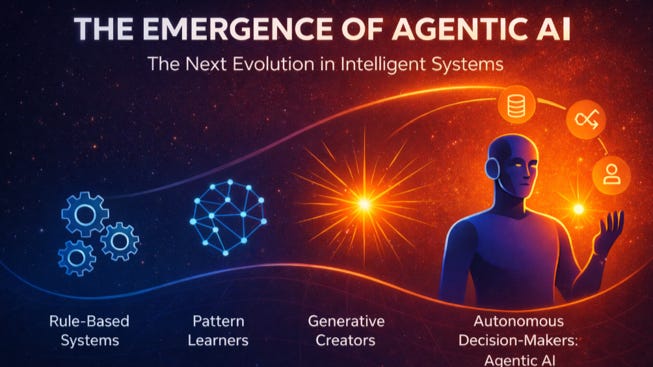
This article launches a new training journey designed to demystify Agentic AI and translate it from buzzword to business capability. The goal is simple but ambitious: equip you with the knowledge, frameworks, and practical tools to understand how agentic systems work, where they create value, and how to deploy them responsibly in technical and enterprise environments.
Agentic AI is not just another wave in the large language model evolution. It represents a structural shift:
From reactive chatbots → proactive agents
From task completion → goal orchestration
From assistance → collaboration
In the short term, organizations will wrap these systems in governance, guardrails, and risk controls. In the long term, they will reshape how workflows, decision-making, and value chains operate across industries.
What You Will Gain from this Series
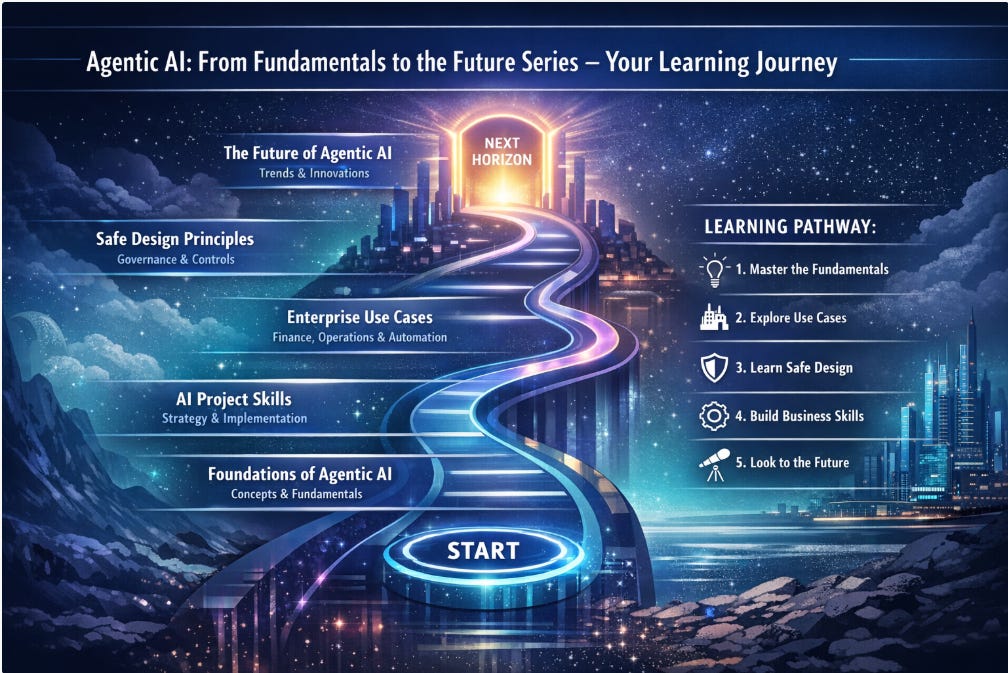
This learning journey is designed for both business and technical professionals who want structured clarity—not hype.
You Will:
1. Master the Foundations
Understand what Agentic AI is, how it differs from traditional AI systems, and the market forces accelerating its adoption.
2. Explore Real Enterprise Use Cases
Examine implementations across industries—with a strong focus on:
Finance
Operations
Enterprise automation
Decision support systems
3. Learn Safe Design Patterns
Learn how to design agents and discover the guardrails, control layers, monitoring approaches, and governance structures needed to build reliable agentic ecosystems.
4. Build Practical Business Skills
Develop the ability to:
Translate business requirements into AI workflows.
Identify high-value automation and augmentation opportunities.
Manage AI-enabled initiatives and projects effectively.
5. Gain Strategic Confidence
Learn how to evaluate when Agentic AI should be applied—and when it should not. Automation. Augmentation. Innovation. Each requires different thinking.
Why This Matters Now
Enterprises are moving beyond experimentation. The conversation is shifting from:“Can AI do this?” to “How do we operationalize this safely and strategically?”
Agentic AI introduces autonomy into business systems. Autonomy increases speed and scale—but it also increases responsibility.
Understanding this balance is no longer optional. It is a leadership capability.
What Comes Next
In this article and upcoming articles, we will explore:
Core architecture of agentic systems
Planning, memory, and tool usage mechanisms
Governance overlays and risk mitigation
Enterprise design blueprints
The future trajectory of AI agents in business and society
This series will move from fundamentals to advanced strategy—step by step.

Introduction
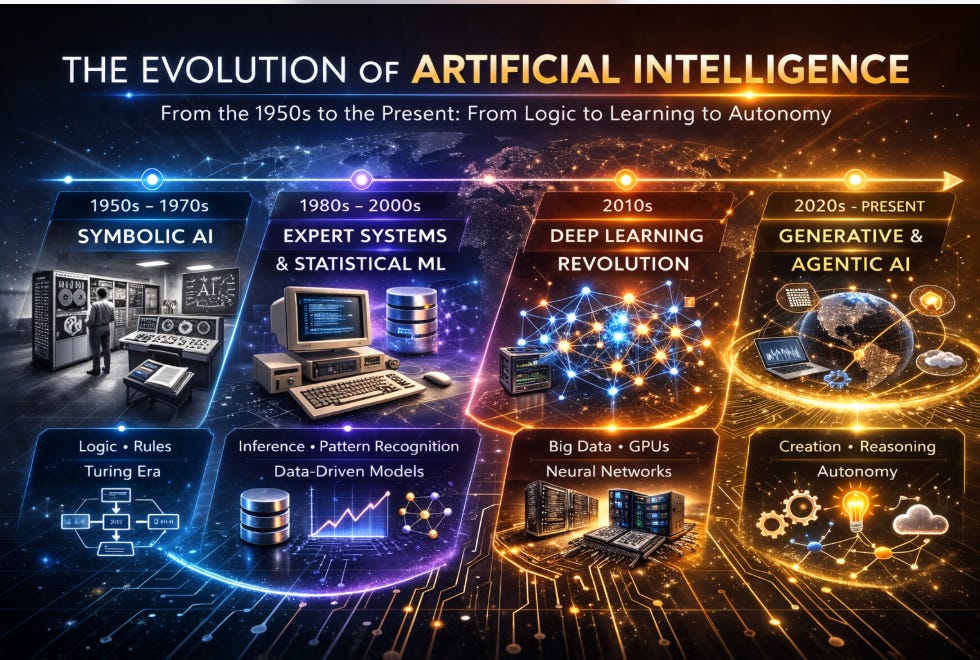
History in one Line:AI evolved from rule-based systems → pattern learners → deep learners → generative creators → and now into autonomous decision-makers: Agentic AI.
Agentic AI systems are systems that don’t just respond to commands but can autonomously decide what actions to take, in what order, and when to stop.
Unlike traditional workflows that follow a fixed sequence, Agentic AI systems are dynamic, adaptive, and capable of handling complex, open-ended problems.
They integrate reasoning, planning, and feedback loops—allowing them to function almost like digital colleagues rather than just tools.
The Big Leap: From Generative to Agentic AI:
Generative AI = Content Creation (text, images, code).
Agentic AI = content + action (decision-making, planning, self-improvement).
Agentic AI represents AI that can:
Interpret goals.
Plan strategies.
Act autonomously.
Reflect and improve
Agentic AI - Definition and Key Concepts
Agentic AI refers to a type of artificial intelligence that can act independently and make decisions to achieve a specific goal without constant human supervision. Unlike traditional AI, which typically follows predefined rules and requires a user prompt for every action, agentic AI has a higher degree of autonomy.
Key Features
Autonomy: The core idea is that the AI has "agency"—the ability to act on its own initiative. It can perceive its environment, reason about it, and act.
Decision Making:It figures out the necessary sequence of tasks, not just one step.
Goal-Oriented: The system is designed to achieve a specific, high-level goal. It can break down a complex task into smaller steps and figure out how to accomplish them. For example, instead of just responding to a prompt, an agentic AI could be tasked with "book a flight to London" and then perform all the necessary sub-tasks, like searching for flights, checking prices, and filling out booking forms.
Adaptability: Agentic AI systems can learn from the results of their actions. They evaluate whether their plan was successful and use that feedback to adjust their future behavior, allowing them to improve over time.
Tool Use: These systems can access and use external tools, such as web browsers, APIs, or other software, to complete tasks. They go beyond simply generating text or images by actually executing actions in the real world (or a digital equivalent).
How does it work (Simple Use Case)
Imagine you ask a normal AI chatbot:“Give me 5 dinner ideas.”
Chatbot:“Here are 5 dinner ideas.”
Now imagine you ask an Agentic AI:
You:“Plan me a dinner party.”
Agentic AI:
Decides it first needs to know your budget and guest count → asks you.
Once it knows, it searches for recipes, checks your pantry, and makes a shopping list.
Then, it might even book grocery delivery.
👉 The chatbot just responds. The agent thinks in steps, makes choices, and takes action.
Distinction from Generative AI Chatbots: While agentic AI often uses large language models (like the ones that power generative AI) as its "brain" for reasoning, its primary function is to act, not just to create. Generative AI creates new content, while agentic AI orchestrates a series of actions to achieve a goal.
The Common Hallmarks of Agentic AI
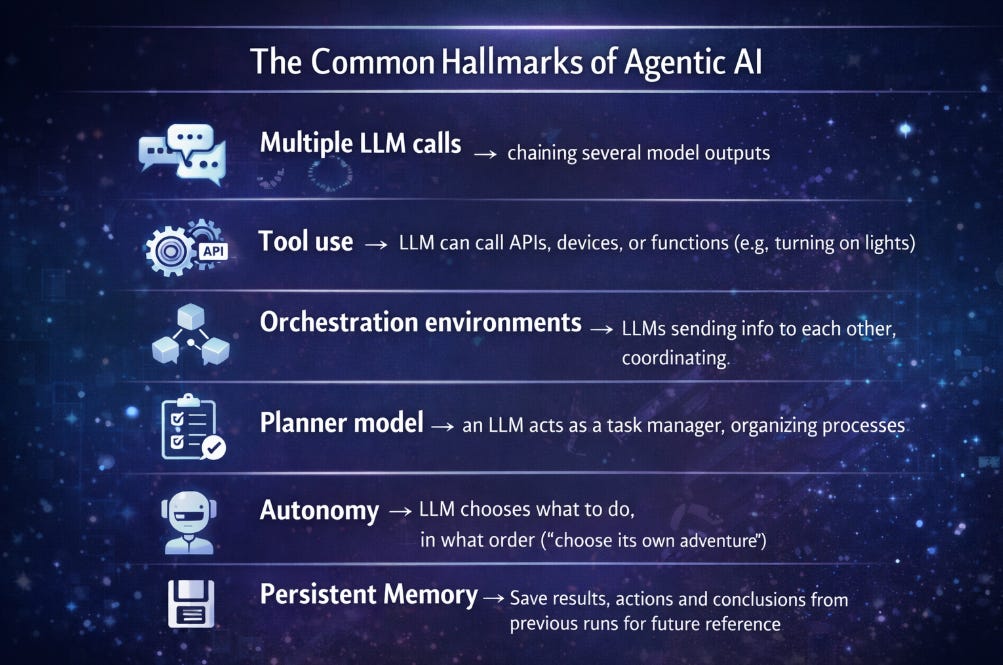
Multiple LLM calls → chaining several model outputs.
Tool use → LLM can call APIs, devices, or functions (e.g., turning on lights).
Orchestration environments → LLMs sending info to each other, coordinating.
Planner model → an LLM acts as a task manager, organizing processes.
Autonomy → LLM chooses what to do, in what order (“choose its own adventure”)
Persistent Memory-> Save results, actions and conclusions from previous runs for future reference.
The Two Categories of AI Agents:
Workflow AI Agents:Agents that follow a predefined sequence of steps
Open-Ended Autonomous Agents:Agents that can adapt dynamically without a fixed path.
We will discuss this distinction, and the features of each category in details in the next article.
Agentic AI Ecosystems - Today and the Future
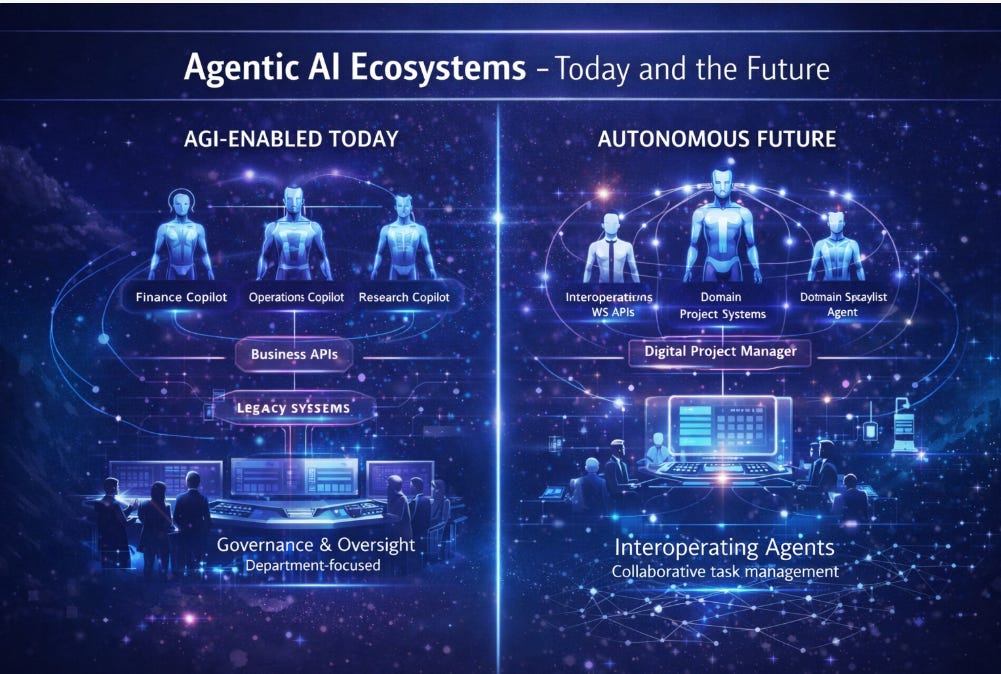
What Agentic AI is Today
AI systems that don’t just generate responses but can take initiative, make decisions, loop through tasks, and coordinate with other agents/tools.
Key Traits:
Autonomy: Not locked into a fixed workflow; capable of feedback loops and adapting dynamically.
Multi-step reasoning: Can plan, decompose tasks, and handle unexpected changes.
Integration: Able to trigger APIs, query databases, send emails, or even trade securities.
Examples of Agents in Current Production Environments:
Banking: Reconciliation bots, trade assistants, regulatory copilots.
Enterprise: Multi-agent copilots for finance, HR, supply chain.
Consumers: AI that books flights, manages calendars, and even negotiates contracts online.
Near-Term (Present - 1 Year)
Standardization of Agent Frameworks
Today’s chaos (LangChain, LangGraph, AutoGen, CrewAI, Swarm) will settle into enterprise-grade frameworks with guardrails, observability, and compliance baked in.
Expect "Agent Operating Systems" to emerge—platforms for orchestrating multiple AI agents with governance and monitoring.
Tighter Controls & Guardrails
Expect built-in policy engines: Who can act on what? Which tasks need human-in-the-loop approvals?
Integration with audit logs and risk registers will make agents trustworthy for regulated industries like finance and healthcare.
Rise of Agent Marketplaces
Think “App Store”for AI agents: pre-built, specialized modules (Tax Advisor Agent, Fraud Detection Agent, Deal Negotiation Agent).
Enterprises will mix-and-match agents instead of building from scratch.
Mid-Term (1 - 3 Years)
Enterprise Autonomy
Agentic AI will run end-to-end business processes—closing books, executing trades, onboarding employees—with humans supervising outcomes, not steps.
Expect shift from augmentation → automation → orchestration.
Agentic Ecosystems Agent-to-Agent Communication
Corporate ecosystems of agents negotiating with client/partner ecosystems.
Example: A trade agent negotiating directly with another trade agent milliseconds, with humans just setting risk parameters.
Multi-Agent Collaboration
Agents will specialize (researcher, planner, critic, communicator) and work as “teams.”
Future corporate projects might be run by human + AI squads, with AI project managers coordinating human and agent work.
Domain-Specific Super-agents
Sector-focused “super agents” emerge — Finance-GPT, Legal-GPT, Pharma-GPT — trained deeply in domain data, regulations, and best practices.
Embedded in Infrastructure
Operating systems, productivity suites, and ERPs will ship with built-in agentic orchestration.
AI will stop being a “tool” and start being theenvironmentyou work in.
Long-Term Outlook (3 - 5+ Years)
Self-Improving Agents
Agents that optimize their own prompts, retrain small modules, and expand capabilities—blurring into autonomous learning systems.
Raises both huge opportunities (continuous improvement) and risks (alignment drift).
Human-AI Symbiosis
Agentic AI as true colleagues: trusted, accountable, with explain-ability and ethics embedded.
Humans shift toward strategic, creative, and oversight roles while agents execute operational complexity.
Recap and Conclusion
This first article in the Agentic AI –From Fundamentals to the Future series laid the foundation for understanding what makes Agentic AI different—and why it matters now. We clarified that Agentic AI is not just a technical upgrade—it is a structural shift in how intelligence is embedded into workflows. It represents a transition from AI as a tool to AI as an actor within systems.
As organizations move from experimentation to production, the real differentiator will not be who adopts agents first—but who implements them with governance, clarity of purpose, and strong human oversight.
Thiswill be about redefining the boundary between human judgment and machine execution.
Strategic literacy in Agentic AI is becoming a leadership capability—not just a technical skill.
Final Reflection
If Generative AI taught machines to create, Agentic AI teaches them to decide and act.
The question is no longer “Can AI generate?” It is “How do we govern intelligence that acts?”
And that is the journey this series will continue to explore.


Explore more: Start Here · Topics · Archive · About