


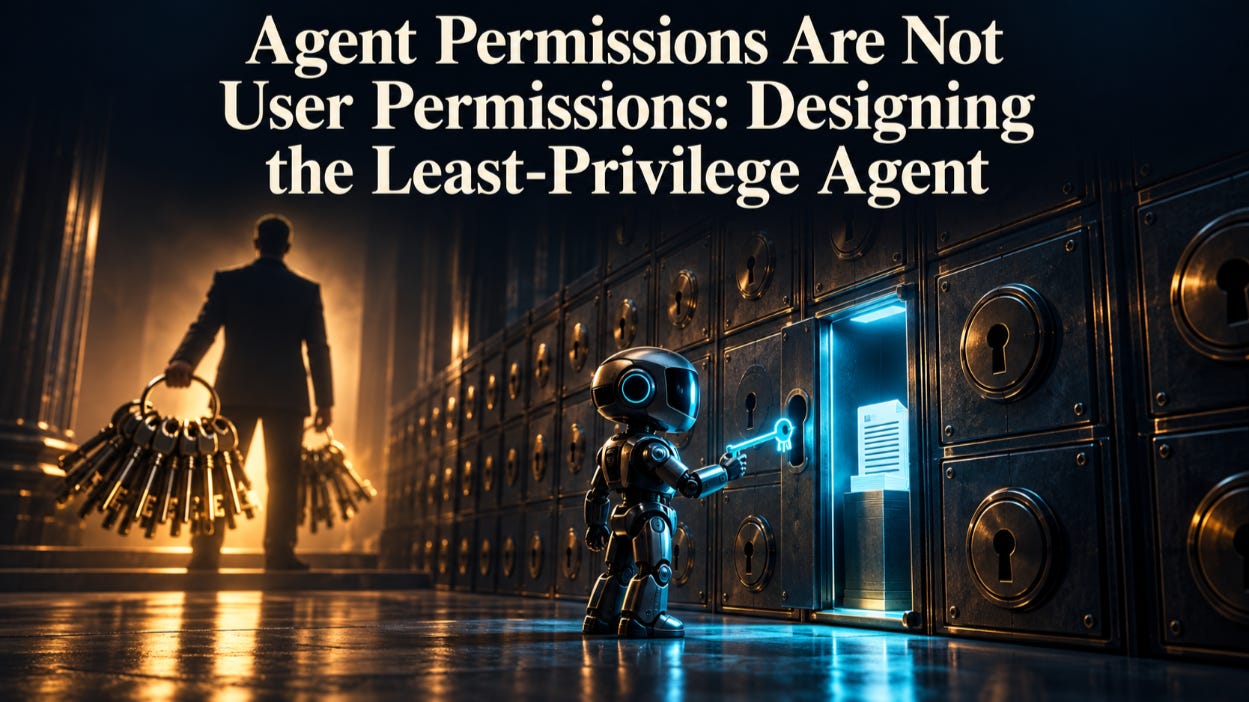
When an organization deploys its first Artificial Intelligence (AI) agent, the quickest way to make it useful is to let it do anything the user can do. It feels natural:the agent works for the user, so it should have the user's access.
That shortcut is one of the most common and most dangerous design decisions in agentic AI. A person with broad access exercises judgment, works at human speed and notices when something looks wrong. An agent with the same access does none of those things reliably.
In this article, you will learn:
Why agents should never simply inherit their user's permissions
How to give every agent its own identity
How to scope agent access to the task instead of the person
Why agent access should be temporary by default
How to tier actions by impact and decide when a human must approve
Which guardrails and logs keep agents accountable
1. Why Inheriting User Permissions Is Dangerous
Most people have far more access than any single task requires. That is tolerable for humans because people self-limit. Agents do not, and they bring new risks of their own:
Speed and scale: an agent can read, change or send thousands of records before anyone notices a problem.
Manipulation: content an agent reads, such as an email or web page, can contain instructions designed to redirect it, a technique called prompt injection.
No natural pause: a person hesitates before deleting a folder or paying an invoice. An agent does not hesitate unless you design the pause.
Compounding chains: one request can trigger many tool calls, and each step inherits whatever access the agent holds.
Blurred accountability: when the agent uses the user's own credentials, logs cannot tell what the person did from what the agent did.
A person's access is limited by judgment. An agent's access must be limited by design.
2. Give Every Agent Its Own Identity
Least privilege starts with knowing who is acting. Treat agents as first-class identities in your access model:
Distinct identity: every agent, or every agent type, gets its own identity rather than borrowing a person's login or a shared service account.
On behalf of: every action records both the agent and the person it acts for, so accountability stays clear.
Named owner: every agent has a human owner responsible for its purpose, permissions and behavior.
Agent registry: keep an inventory of agents, their owners, what they can reach and when their access was last reviewed.
If you cannot name the agent, its owner and its purpose, you cannot govern what it does.
3. Scope Access to the Task, Not the Person
A practical rule: an agent's effective access should be the overlap of three things, never more than any one of them.
What the user may access: the agent never exceeds the permissions of the person it serves.
What the agent is designed for: an expense agent has no business in personnel files, even if its user does.
What the current task requires: summarizing one contract needs read access to that contract, not to the whole document library.
Examples make the principle concrete:
A bank'sresearch agent can read market reports but not client account data.
A hospital's scheduling agent can see appointment slots but not clinical notes.
A law firm's drafting agent can read the matter it was opened on, but not matters behind an ethical wall.
Grant the overlap, never the union. The task defines the boundary, not the job title.
4. Make Access Temporary by Default
Standing access is access waiting to be misused. Design agent permissions to expire:
Just in time: grant access when the task starts, not when the agent is created.
Short-lived credentials: issue tokens that expire in minutes or hours, not months.
Release on completion: revoke access as soon as the task finishes or fails.
Step up when needed: request additional permission at the moment a higher-risk action is attempted, rather than granting everything upfront.
The safest permission is the one that no longer exists when the task is done.
5. Tier Actions by Impact
Not every action deserves the same scrutiny. A simple tiering model helps teams decide where autonomy is safe and where a person must stay in the loop:
Read: retrieving and summarizing information. Usually safe to automate within scope.
Draft: preparing an email, document or record for a person to review. Safe when nothing leaves without review.
Act internally: updating a record, filing a ticket or scheduling a meeting. Automate with limits and logging.
Act externally or irreversibly: sending messages outside the organization, moving money, deleting data or submitting filings. Require explicit human approval.
The tiers look different by industry:
In banking, moving funds is tier four.
In healthcare, changing a medication order is tier four.
In legal services, filing a document with a court is tier four.
The discipline is the same everywhere:the more irreversible the action, the more human the approval.
Autonomy should shrink as consequences grow. Let agents read freely and act carefully.
6. Put Guardrails Around the Loop
Even well-scoped agents can misbehave through bugs, bad instructions or manipulated content. Guardrails limit the damage:
Rate limits: cap how many actions an agent can take per minute or per task.
Budget caps: limit spend, transaction values or the number of records touched.
Step limits: stop runaway loops after a set number of steps.
Dry runs: let agents show what they would do before they do it, for new or risky workflows.
Kill switch: give administrators a way to pause an agent, or all agents, instantly.
Guardrails do not slow good agents down. They stop bad days from becoming bad headlines.
7. Log, Review and Recertify
Agents need the same oversight disciplines organizations already apply to people, adapted for machine speed:
Complete audit trail: record the agent, the user it acted for, the tool used, the data touched and the outcome.
Access reviews: include agents in periodic access recertification, and remove permissions they no longer use.
Anomaly detection: flag unusual volumes, new destinations or actions outside the agent's normal pattern.
Outcome review: sample agent actions regularly to confirm they match what the owner intended.
What an agent does in the dark, it does without accountability. Turn on the lights.
8. A Least-Privilege Agent Checklist
Use these questions before any agent goes into production:
Does the agent have its own identity and a named human owner?
Does every action record both the agent and the person it acts for?
Is access limited to the overlap of the user, the agent's purpose and the task?
Do credentials expire automatically when the task ends?
Are actions tiered by impact, with human approval for irreversible ones?
Are rate limits, budget caps and a kill switch in place?
Is the agent included in regular access reviews?
Least privilege is not a setting you switch on once. It is a habit you design into every agent.
Conclusion: Key Takeaways
Agents are not users, and treating them as users hands them access they cannot handle responsibly. The organizations that scale agentic AI safely will be the ones that design agent permissions from the ground up.
Never let agents simply inherit their user's permissions.
Give every agent its own identity, owner and audit trail.
Scope access to the overlap of user, agent purpose and task.
Make access temporary, and step up only when needed.
Tier actions by impact, with humans approving irreversible ones.
Surround agents with guardrails, logs and regular reviews.
Whether your agents reconcile accounts, schedule patients, draft contracts or answer customers, the same rule applies: give them exactly what the job needs and nothing more.
Trust in agents is earned one well-scoped permission at a time.
How does your organization decide what an AI agent is allowed to do? Share your approach in the comments.
Explore more: Start Here · Topics · Archive · About